
By the end of this post, you will understand what the S&P 500 is, how its score is worked out, and what that famous number does — and does not — tell you.
For years, I heard the same sentence on the news every night: “the S&P 500 rose today.” I nodded along like everybody else. But if anyone had asked me what had actually risen — a company? a price? a place? — I could not have answered. And so I stayed away, while inflation ate my savings. A big mistake – and my loss.
The embarrassment was unnecessary. It is one of the simplest ideas in investing, once it is explained in plain English.
The short answer: it is a scoreboard, not a company
The S&P 500 is an index. An index is a list of companies, combined by a fixed rule into a single number, so you can see at a glance how the whole group is doing. In other words, a scoreboard.
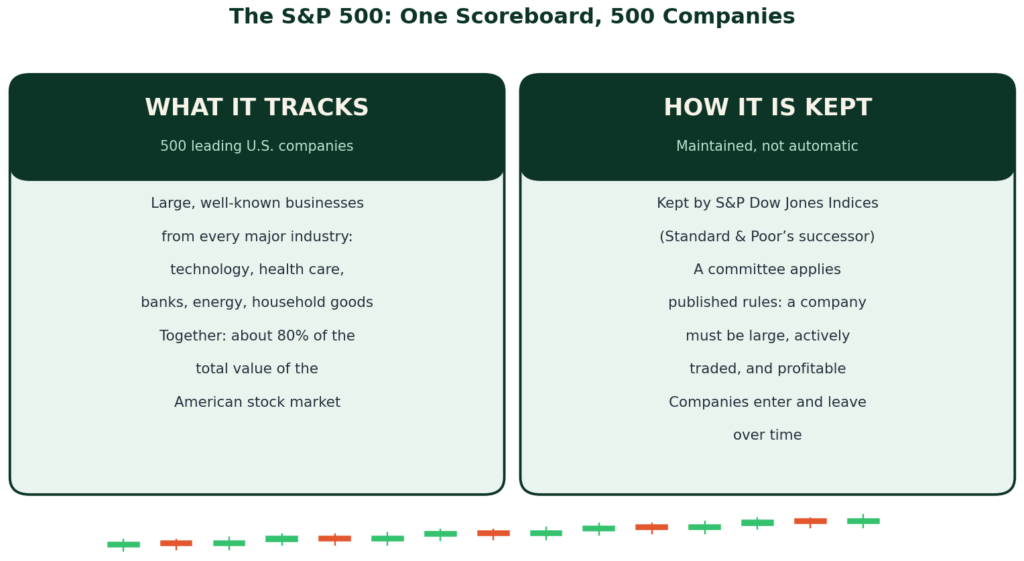
This scoreboard tracks five hundred (500) leading companies in the United States — large businesses from every major industry, from technology and health care to banks and energy. Together, they represent roughly eighty percent (about 80%) of the total value of the American stock market. “S&P” stands for Standard & Poor’s, the firm that introduced the index in its present form in 1957; its successor, S&P Dow Jones Indices, maintains it today.
Now that you know what a share is, the score makes sense
In the previous posts, you learned what a stock is, what the market is, and what a share is. This is where the pieces come together: when a headline says “the market rose today,” it usually means, more accurately, that this scoreboard rose.
Companies are not chosen by lottery. A committee applies published rules — a company must be large, actively traded, and profitable, among other tests — and companies enter and leave over time as businesses grow, shrink, merge, or fail. The scoreboard is maintained, not abandoned.
Why the big companies move the score the most
The S&P 500 is market-capitalization weighted. Market capitalization — market cap, for short — is a company’s total value: share price multiplied by total shares. Bigger companies therefore count for more in the score. Much more.
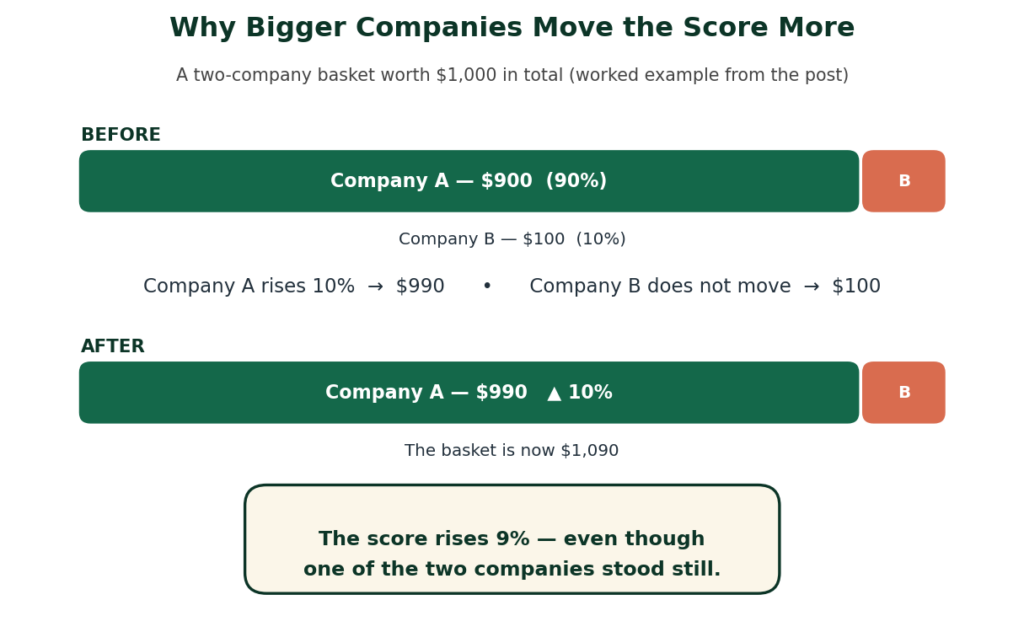
Let us make this concrete. Suppose a tiny two-company index holds Company A, worth nine hundred dollars ($900), and Company B, worth one hundred dollars ($100). The basket is worth one thousand dollars ($1,000), so Company A is ninety percent of it (900 ÷ 1,000 = 90%) and Company B is ten percent (10%).
Now suppose Company A rises ten percent (10%) and Company B does not move. Company A becomes nine hundred ninety dollars ($990), the basket one thousand ninety dollars ($1,090) — up nine percent (9%), though one company stood still. That is the nugget of gold in this post: when a few very large companies move, the scoreboard moves, whatever the other hundreds are doing.
How to read the number like a regular person
So when you hear the S&P 500 rose one percent (1%) today, amend it in your mind to this: “on balance, those five hundred companies, weighted by size, are worth about one percent more than yesterday.” It does not mean every stock rose — hundreds can fall while the giants carry the score upward.
What the S&P 500 is not
It is just as important to understand what the S&P 500 is not.
It is not a company, and it is not a stock. You cannot buy a share of the S&P 500 itself — it is a measurement, like a thermometer; there is nothing to own. What people actually buy, to follow it, is a fund built to track it: an index fund or an exchange-traded fund holding the same companies in the same proportions. Illustrations here, never a recommendation.
It is not the whole market, either. It leaves out thousands of smaller companies, along with bonds and real estate. Eighty percent is a large share — still not one hundred percent.
And it is not a promise. The scoreboard has climbed over long stretches and fallen hard in bad years, and it will do both again. There is no such thing as a completely safe stock — or a completely safe index of stocks.

Bottomline
The S&P 500 is a scoreboard: five hundred leading American companies in one number, the biggest counting the most. When it rises or falls, it tells you how that group did — weighted by size, on balance, nothing more mysterious than that.
If you found this helpful, my free ebook, The Story of the Stock Market, goes deeper — same plain English, no jargon, no hype. Grab it free at acdspublishing.com.
— Alex
P.S. This post is for education, not financial advice. I am an educator, not a financial advisor. Investing involves real risk — never invest money you cannot afford to lose, and consider a qualified professional for your own situation.