
By the end of this post, you will understand what a stock actually is — and what it is not.
Let me start with a confession. For years, I kept my savings in a regular bank account while inflation quietly ate away at it, year after year. I knew the stock market existed. Everybody and their brother seemed to be making money in it. But I never took the time to understand the most basic question of all: what is a stock?
A big mistake – and my loss. Because once you understand what a stock really is, the whole market becomes far less intimidating.
A stock is a slice of a real business.
That is the whole idea, in one sentence. When you buy a share of stock, you are buying a small slice of ownership in a real company — a company with employees, products, customers, and revenue. You become what the investment community calls a shareholder. In other words, you become a part-owner.
Think of it like a pizza. Suppose three friends start a pizza shop called Eat Pizza Inc. The shop is worth $30,000, and they slice the ownership into 3,000 equal slices. Each slice — each share — is worth $10. If you buy 10 slices, you own 10 out of 3,000 slices of the shop. Put differently, you own a small piece of a real business that sells real pizzas to real customers.
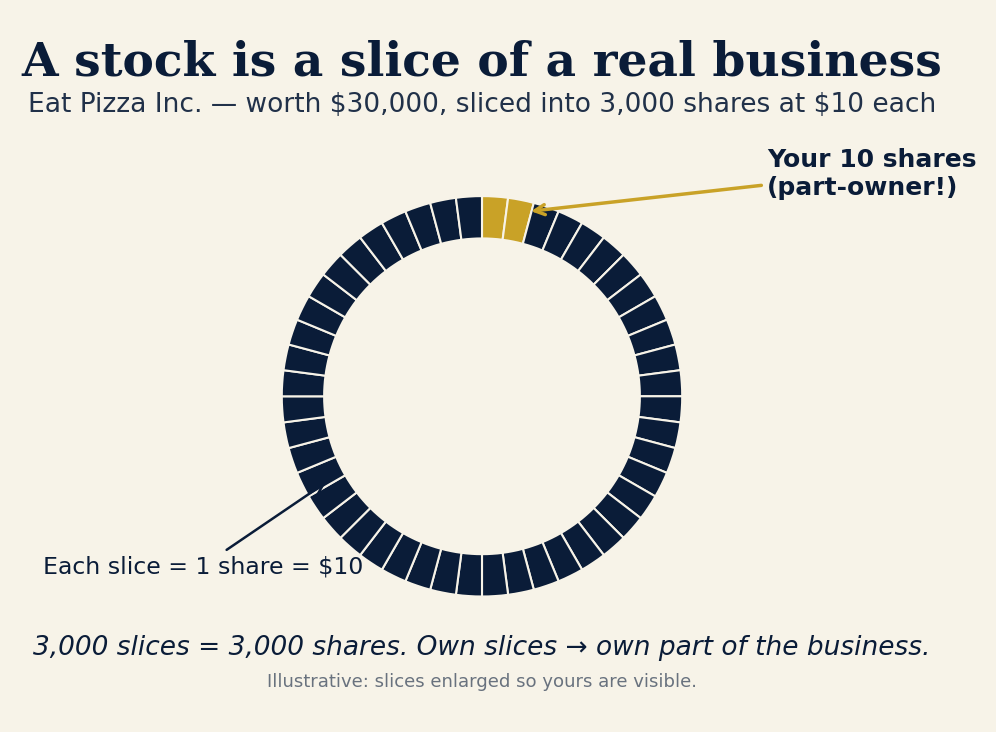
And so, owning stock is not owning a lottery ticket. It is owning a piece of a business.
More accurately, it is owning a piece of a business’s future profits. When Eat Pizza Inc. does well and earns more money, each slice becomes more valuable. When it struggles, each slice becomes worth less. The price of your slice simply reflects what other market participants believe the business is worth at that moment.
What a stock is not
Now that you know what a stock is, it is just as important to understand what it is not.
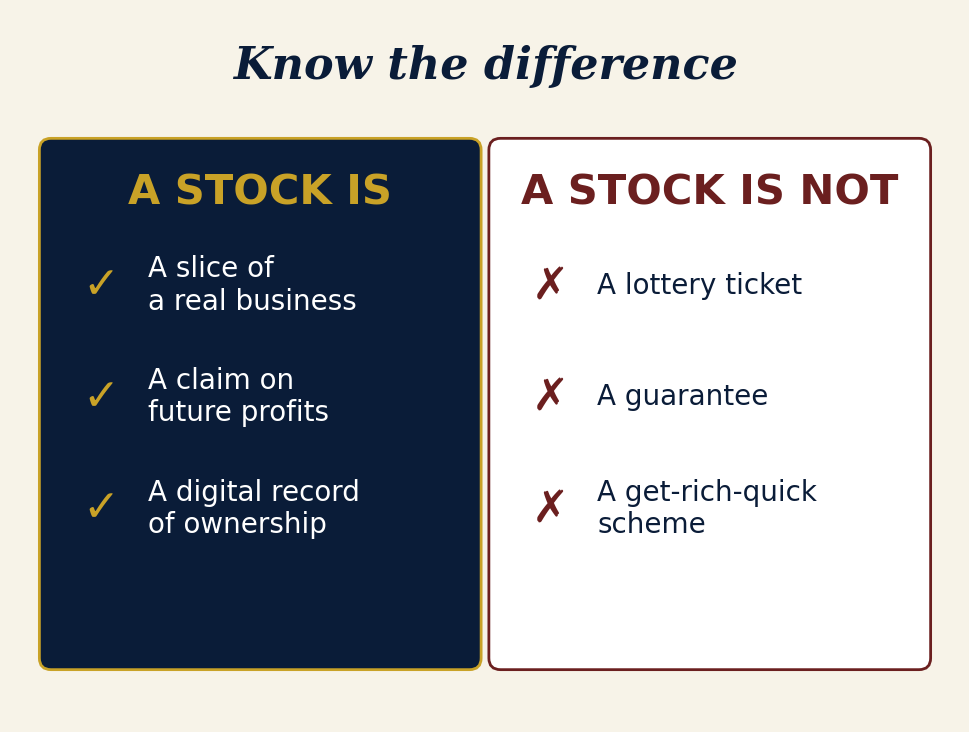
A stock is not a get-rich-quick scheme. It is not gambling — though plenty of newbies treat it that way, jumping headlong into “hot tips” and banking on luck. (There is a 100% chance of making at least one mistake as a beginner; the goal is to make your mistakes cheap.)
A stock is not a guarantee, either. There is no such thing as a completely safe stock. Prices go up and prices go down, sometimes in the blink of an eye, for reasons that have nothing to do with the business itself.
And a stock is not a physical thing you can hold. It is a digital record of your ownership — a claim on a slice of the company. Simple, but do not make the mistake of thinking it is easy, because it is not.
Why do stock prices move?
In a nutshell: prices move because people’s opinions about a business change. When a company reports strong earnings, investors line up to buy, and the price rises. When bad news hits, they drop its shares like hot potatoes, and the price falls.
On the one hand, the price reflects the company’s actual performance — its sales, its profits, its growth. On the other hand, it reflects emotion: fear, greed, excitement, panic. Granted, investing can be an emotional business. That is why the most important skill is not picking the perfect stock — it is keeping a cool head when everyone else is losing theirs.
Bottomline
A stock is a slice of ownership in a real business. Its price goes up and down as the business performs and as market participants change their minds about what it is worth. It is not a lottery ticket, not a guarantee, and not a shortcut to wealth. But understood properly, it is one of the most powerful wealth-building tools available to regular people like you and I.
If you found this helpful, I have a free ebook for you — Story of the Stock Market: four investment lessons from the Roaring Twenties, the Great Depression, and the Great Recession, written in the same plain English, no jargon, no hype. You can grab it at acdspublishing.com and join my newsletter while you are there. I write about this stuff every two weeks, and I would love for you to follow along.
— Alex
P.S. This post is for education, not financial advice. Investing involves real risk — never invest money you cannot afford to lose, and consider speaking with a qualified professional before you begin.