
By the end of this post, you will understand what a market bubble actually is, the five stages every bubble passes through, and the questions a careful beginner asks when everyone else is shouting.
Open any financial page this month and you will meet the same argument, carried on at full volume. Artificial intelligence is changing the world, says one side. Artificial intelligence is a bubble, says the other — and bubbles burst.
Both sides speak with total confidence. And so the beginner is left in the worst possible seat: too frightened to invest at all, or too frightened of missing out to think clearly. Fear on one side, greed on the other.
Let us fix that. This post will not tell you whether AI stocks will rise or fall — no honest person knows that. What it will do is teach you what the word “bubble” actually means, so you can judge the shouting for yourself.
What a bubble is
A bubble is what happens when the price of something rises far above its real value — not because the thing became worth so much more, but because buyers expect to sell it to someone else at an even higher price.
That expectation is the whole engine. In a healthy market, people buy an investment for what it produces: a company’s profits, a bond’s interest, a property’s rent. In a bubble, people buy mainly because the price has been going up. And so the price rises because people are buying, and people keep buying because the price is rising — a circle that feeds on itself until it cannot.
The five stages of every bubble
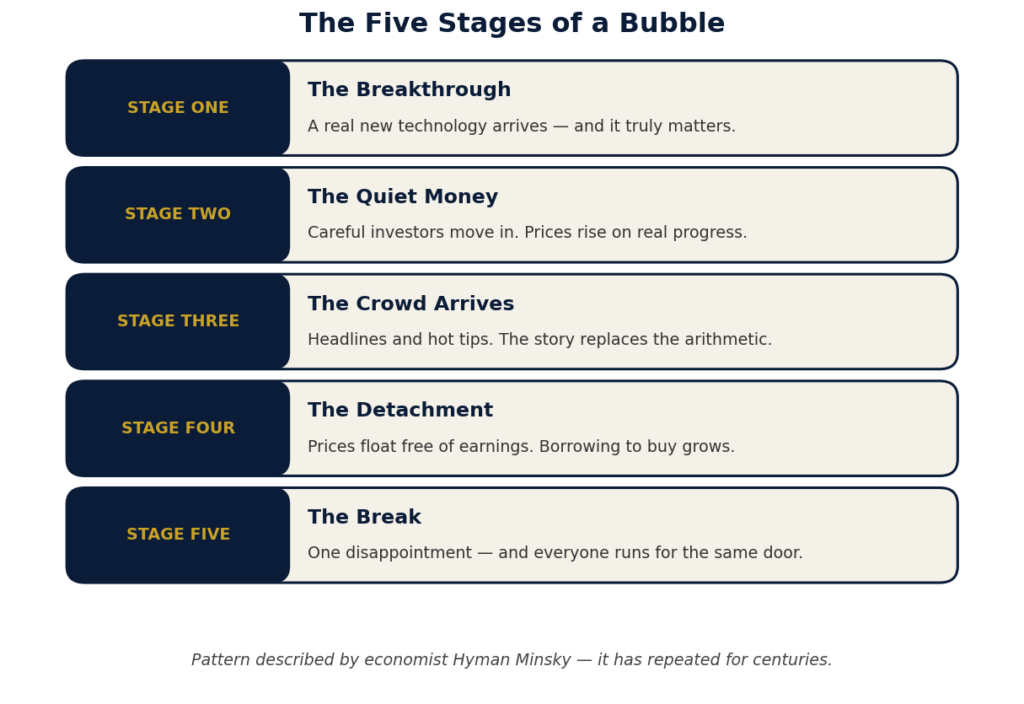
The economist Hyman Minsky described how bubbles form, and the pattern has repeated for centuries. The first stage is a real breakthrough — a genuine new thing appears, and it truly matters. The second stage is quiet money: careful investors move in, and prices rise on real progress.
The third stage is the crowd. Headlines multiply, beginners rush in, and the story replaces the arithmetic. The fourth stage is the detachment: prices lose their connection to what the companies actually earn, borrowing to buy becomes common, and anyone who asks about value is called a fool. The fifth stage is the break — one disappointment lands, everyone runs for the same door, and prices fall faster than they rose.
The last time this happened: the dot-com bubble
We have watched this film before. In the late nineteen nineties, the internet was the breakthrough — and it was real. Companies with no profits, some with barely any revenue, sold shares to an eager public. A pet-supply website became worth a fortune on paper. The Nasdaq index, heavy with technology stocks, climbed to 5,048 in March of 2000.
Then came the break. By October of 2002, the Nasdaq had fallen to about 1,114 — a drop of roughly seventy-eight percent. Investors who bought near the top waited about fifteen years for the index to climb back to its old peak. Trillions of dollars of paper wealth simply evaporated.
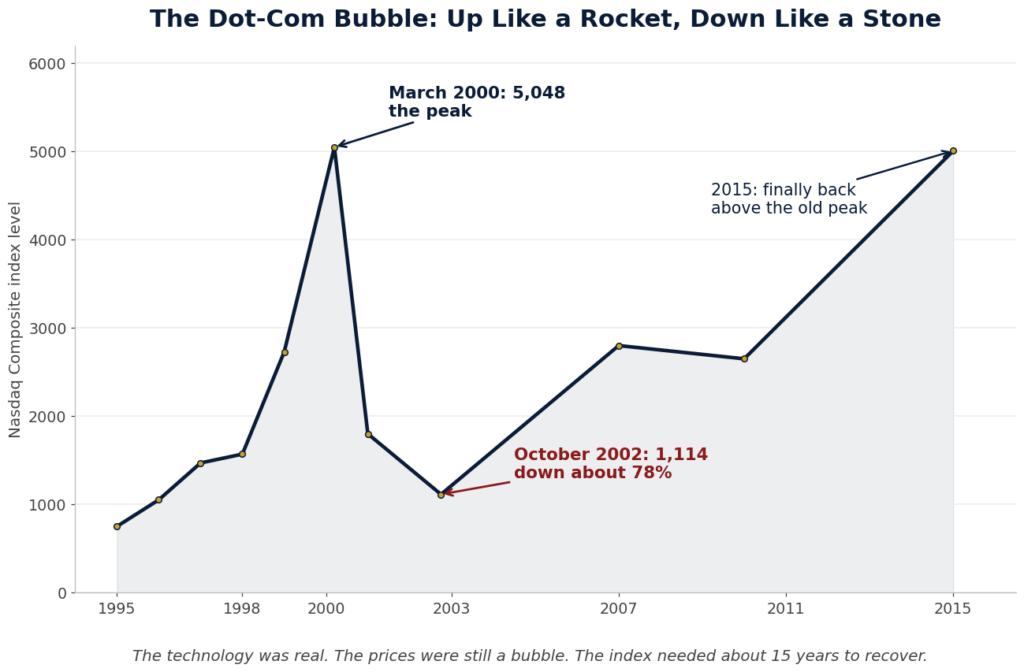
But here is the part of the story that gets left out. The internet itself was not a fraud. It really did change the world — shopping, banking, communication, everything. The technology was real, and the prices were still a bubble. Hold on to that distinction, because it is the nugget of gold in this post: a thing can be genuinely revolutionary and still be wildly overpriced. Both can be true at the same time.
What a bubble is not
Just as important is what a bubble is not. A bubble is not every falling price. Stocks fall ten or twenty percent in perfectly ordinary years; that is the market breathing, not bursting. A bubble is not every expensive stock, either — a strong company growing fast can deserve a high price. And a new technology is not a bubble just because it is new, or because it is popular.
More accurately, the bubble never lives in the technology. It lives in the prices people pay for it, and in the borrowed confidence underneath those prices.
So what should a beginner watch?
You do not need to call the top, and you should distrust anyone who claims they can. Instead, ask the questions that never go out of style. What does this company actually earn today — not promise to earn someday? If the story stopped being exciting tomorrow, would the business still make money? Am I buying because I understand it, or because I am afraid of being left behind?
And keep the oldest defenses in place. Own a diversified mix rather than one exciting story, and invest money you will not need soon, so a bad year cannot force you to sell. A fall in price is only a disaster for the investor who must sell, or who borrowed to buy — the investor with time, no debt, and a real understanding of what they own can afford to let the shouting pass.
Bottomline
A bubble is a price that has floated away from value on a cushion of borrowed confidence — and it follows the same five stages every time. Artificial intelligence may prove to be the biggest story of our lifetimes, and some of its prices may still be ahead of reality; history says both can be true at once. Your protection is not predicting the break. Your protection is understanding what you own, paying a sane price for it, and giving it time to be worth what you paid.
If you found this helpful, my free ebook, The Story of the Stock Market, teaches the market’s big lessons in the same plain English — no jargon, no hype. Grab it free at acdspublishing.com. And when you are ready to go deeper on owning the whole market at once, my new book, Introduction to ETFs, launches November 17.
— Alex
P.S. This post is for education, not financial advice. I am an educator, not a financial advisor. Investing involves real risk — never invest money you cannot afford to lose, and consider a qualified professional for your own situation.